

OVERVIEW
ECAS is the operational backbone for Abu Dhabi government entities submitting requests for Executive Council review - a system governing policy, budget, and strategic decisions at the highest level. It allows authorized users to:
Manage Requests: Review and act on tasks or memos submitted to the Executive Council.
Track Projects: View full details, attachments, and tracking history for ongoing government initiatives.
Collaborate: Facilitate communication between various government departments and the Executive Office
The aim of this project was to solve the problem of large group communication and work management for ADEO members through a redesign of the ECAS web application.
Role
GravityOne | Design Strategist
Led the end-to-end design process for the website, from research to final delivery. This included user research, wireframing, prototyping, testing, visual design, and collaborating with developers.
Timeline
4 months (Concept to Launch)
A system central to Abu Dhabi's governance but designed for another era
ADEO's Executive Council Affairs System (ECAS) is the official digital platform through which government entities submit, route, and track strategic requests to the Abu Dhabi Executive Council.
Every budget proposal, regulatory change, strategic initiative, or inter-departmental request flows through ECAS before reaching the Executive Council. Despite its critical role, the system had grown organically over years, accumulating technical debt in its UX, unclear workflows, and significant friction for every user type involved.
ADEO approached with a brief to conduct a full UX audit, understand what's broken, and redesign the system from the ground up, while maintaining alignment with existing governance logic and business rule
Challenge
The review and approval of government requests is inherently collaborative and iterative, but the existing platform is built around rigid, linear workflows. A one-size-fits-all experience across roles creates confusion around responsibilities, next steps, and decision-making, while limited visibility into requests makes collaboration, oversight, and progress tracking difficult. As a result, teams rely on manual workarounds to manage workflows, identify bottlenecks, and coordinate actions across departments.

User Research
We conducted structured interviews with over 20 users across 7 distinct roles within ADEO and associated departments to understand operational workflows, decision-making patterns, and system dependencies.
Our research focused on:
• Understanding the organizational hierarchy and inter-departmental workflows
• Mapping role-specific responsibilities and recurring operational tasks
• Identifying system touchpoints, friction areas, and approval dependencies
• Observing how users tracked requests, monitored progress, and measured task completion
• Uncovering informal workarounds adopted outside the system to compensate for workflow gaps
The research was further supported through workflow observation sessions, where users demonstrated their real interactions with the existing platform, revealing inefficiencies in navigation, request visibility, and cross-functional coordination.
User Research

Role Clarity
The platform follows a one-size-fits-all experience despite users having vastly different responsibilities and decision-making needs.
Personas lack clarity on what is expected of them at different stages of the workflow.
Users struggle to identify the next action required within a request lifecycle.
Navigation does not align with role-specific responsibilities and operational priorities.
Role Clarity
Visibility & Oversight
Analysts have limited visibility into requests across teams and departments.
It is difficult to identify duplicate or overlapping initiatives in context.
Limited oversight creates friction in transferring ownership and coordinating across workflows.
Leadership lacks a centralized view of ongoing work, bottlenecks, and areas requiring intervention.
Workflow & Collaboration
The review and approval process is inherently collaborative, but the system is designed around rigid linear workflows.
Teams rely on manual workarounds to coordinate tasks and track request progress.
Workflow friction slows decision-making and reduces operational efficiency across departments.
Lack of contextual visibility makes collaboration and iterative reviews difficult to manage seamlessly.
How can we create a platform that addresses the informational needs and establishes Inera’s credibility among distributors, retailers, and potential collaborators?
Challenge
73%
of distributors and retailers visit website for detailed product information
91%
retailers conveyed farmers primarily use product pamphlets or packets to identify the product
Top 3
pages visited on competitor websites are Home, product page and About Us
46.3%
traffic on competitor website was done with Informational intent and only 9.1% with transactional intent
Solutions

Interactions

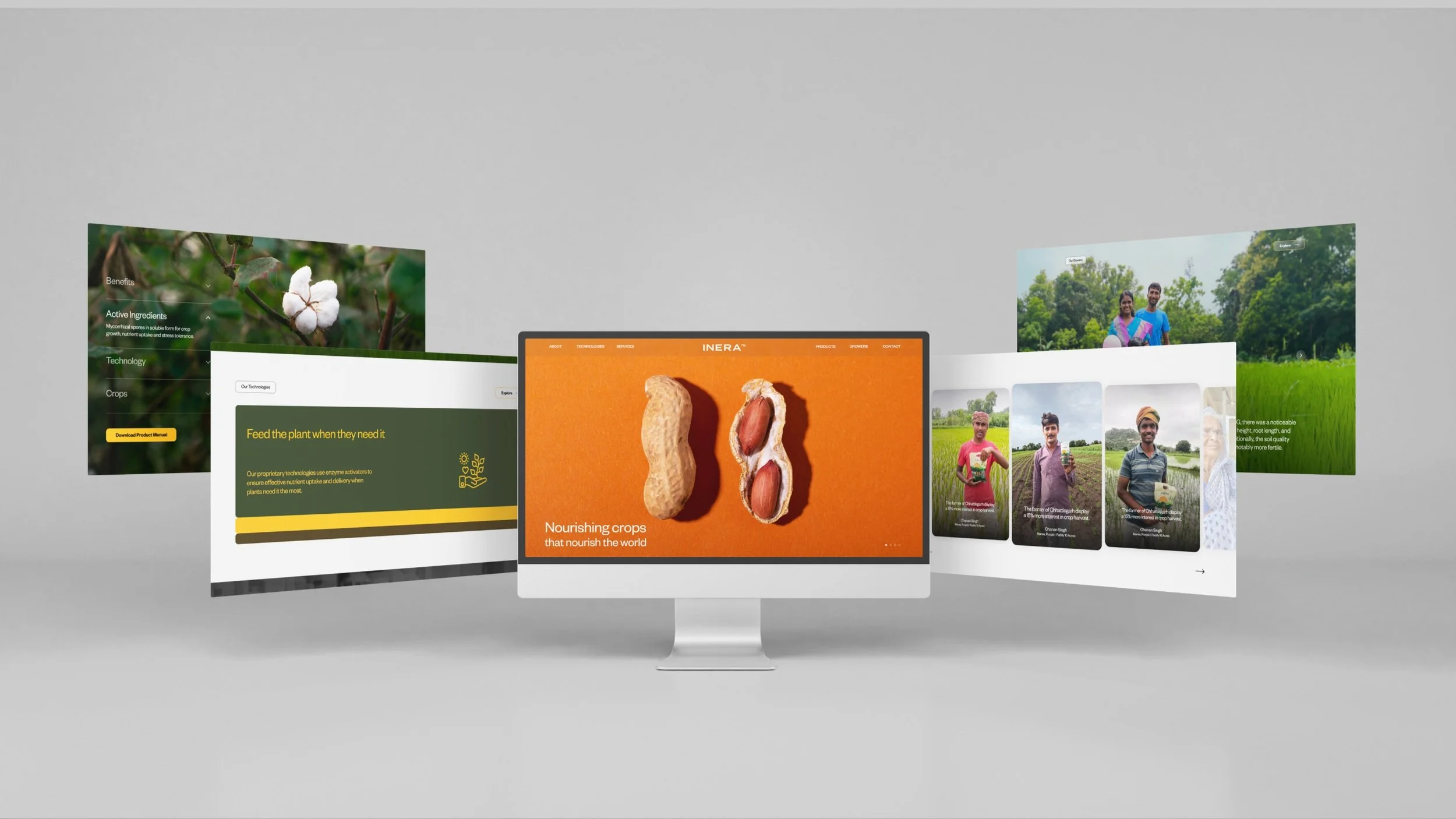


Impact
80%
higher brand recall and comprehensiveness
amongst first time users
95%
users were able to find what they intended to find swiftly
64%
users were able to understand and consume the provided information and connect with the story